When we watch children navigate a playground, we see them testing physical boundaries, calculating distances, and negotiating rules with their peers. What is less visible is the rapid neurological construction happening inside their minds. The concept of neuroplasticity and the playground demonstrates that a child’s brain is a highly adaptable, dynamic system that shapes itself in response to environmental challenges.
Introducing a second language during these formative years does not just add new words to a child’s vocabulary. It fundamentally alters the architecture of their brain. In the modern educational landscape, introducing complex languages like Mandarin or Japanese early in life provides a unique cognitive toolkit. This training fundamentally transforms how children analyze information and solve complex real-world problems.
1. The Adaptive Brain: Understanding Neuroplasticity
Neuroplasticity refers to the brain’s incredible ability to reorganize itself by forming new neural pathways and pruning old ones. During early childhood, the brain is in a state of hyper-plasticity, making it uniquely receptive to complex auditory and visual stimuli.
When a child learns a native language alongside a structurally distinct language like Mandarin or Japanese, their brain must build complex neural networks to manage both systems. According to peer-reviewed studies available on Nature, bilingual children frequently show increased gray matter density in the areas of the brain responsible for executive control and memory.
This structural enhancement means that the intersection of neuroplasticity and the playground is more than a metaphor. The same mental flexibility required to switch between distinct grammar structures enables a child to adapt quickly to shifting rules, social dynamics, and physical obstacles during daily play.
2. Cognitive Flexibility and Character-Based Languages
Different languages challenge the developing brain in distinct ways. Languages such as English rely entirely on an alphabet, whereas Mandarin and Japanese introduce character-based systems and unique tonal variations.
For instance, learning Mandarin requires a child to differentiate between four distinct vocal tones, where the exact same syllable can mean entirely different things depending on the pitch. Meanwhile, studying Japanese introduces logographic characters alongside syllabic scripts. This visual-spatial complexity demands immense focus and cross-hemispheric brain activity.
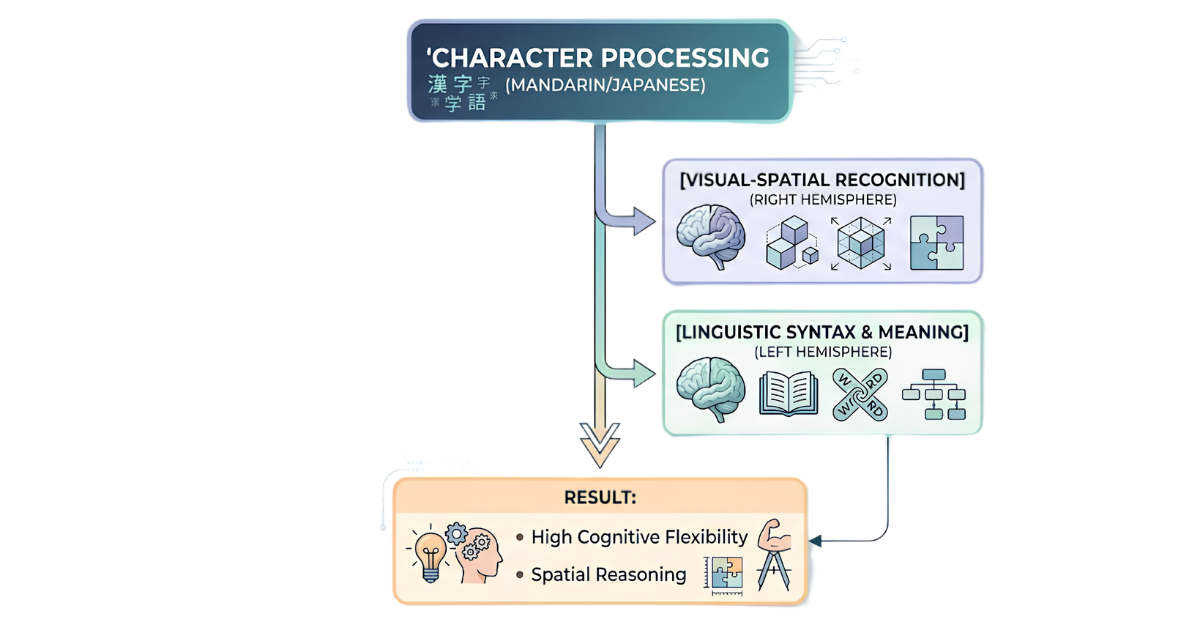
When parents enroll their children in structured programs like Online Mandarin for Kids, they are giving them a rigorous workout in pattern recognition. Deciphering these intricate symbols trains the brain to recognize abstract visual patterns, a core skill that directly translates to advanced math and engineering problem-solving later in life.
3. Strengthening Executive Function Skills
Executive function is the command center of the human brain. It governs working memory, cognitive flexibility, and inhibitory control, which is the ability to filter out distractions and resist impulsive reactions.
Medical resources from Harvard Health Publishing emphasize that robust executive function skills are a stronger predictor of academic and career success than traditional IQ scores. Early language acquisition acts as an ideal training ground for these exact skills. A bilingual child must constantly suppress one language system to speak another, building an internal sorting mechanism that operates continuously behind the scenes.
This constant mental exercise makes young learners exceptionally adept at filtering out irrelevant noise. Whether they are concentrating on a complex puzzle or working through a challenging math equation, their minds are trained to focus on the task at hand. Exploring specialized tracks like Online Japanese for Kids offers an accessible, structured pathway to cultivate this lifelong cognitive resilience.
4. From Neural Pathways to Playground Success
The benefits of early linguistic training extend far beyond traditional classroom walls. A child who has developed high cognitive flexibility through language learning brings those refined problem-solving skills right out to the playground.
When an unexpected obstacle arises during a game, these children are less likely to experience frustration or give up. Their adaptable brains are accustomed to finding alternative paths to express an idea, which allows them to easily find creative alternatives to real-world challenges. They naturally excel at analyzing complex situations, understanding diverse perspectives, and engineering clever solutions on the fly.
Investing in early language learning is one of the most effective ways to maximize a child’s natural neuroplasticity. By exposing them to rich, diverse linguistic systems early on, you give them the cognitive foundation to navigate an increasingly complex world with confidence, creativity, and intellectual agility.





Leave a Reply
Want to join the discussion?Feel free to contribute!